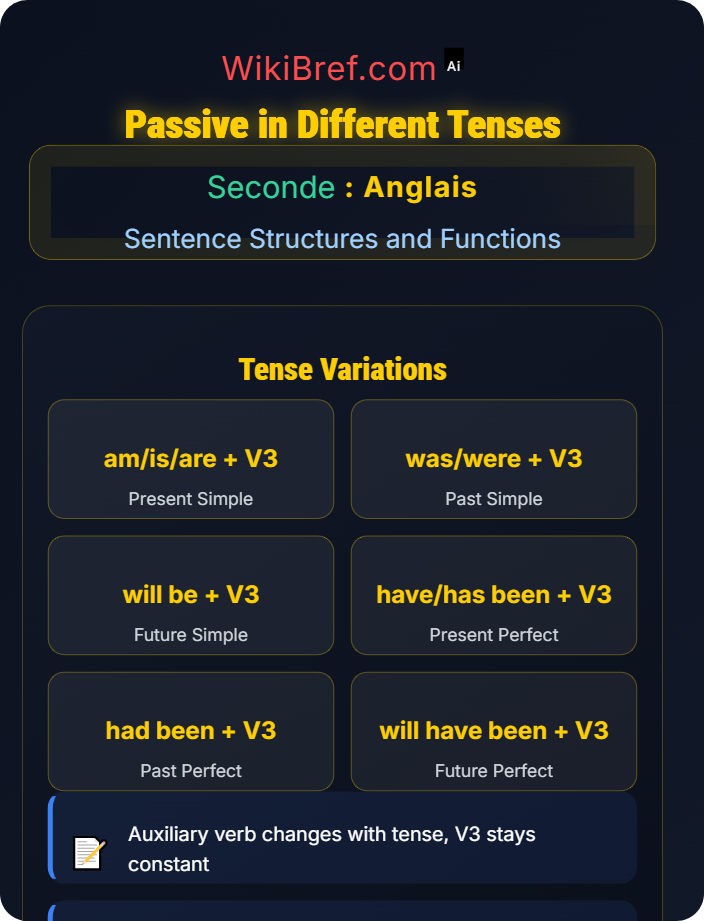
Present continuous passive : Structure: am/is/are + being + past participle.
- Identifier le temps actif: present simple → convertir en present continuous
- Transformer: objet → sujet, sujet → agent
- Appliquer la structure passive: am/is/are + being + past participle
- Changer le verbe principal en participe passé
"They build houses" → Sujet: "they", Verbe: "build", Objet: "houses"
Présent simple "build" → present continuous "are building"
Objet "houses" devient sujet → "Houses are being..."
"Build" → "built" (verbe irrégulier)
"Houses are being built (by them)"
"Houses are being built (by them)"
• Present continuous passive: am/is/are + being + past participle
• Verbe irrégulier: build → built
• Temps conservé: Present continuous → are being + past participle
Past perfect passive : Structure: had + been + past participle.
"She wrote a letter" → Sujet: "she", Verbe: "wrote", Objet: "a letter"
Past simple "wrote" → past perfect "had written"
Objet "a letter" devient sujet → "A letter had been..."
"Write" → "written" (verbe irrégulier)
"A letter had been written (by her)"
"A letter had been written (by her)"
• Past perfect passive: had + been + past participle
• Verbe irrégulier: write → written
• Temps conservé: Past perfect → had been + past participle
Future perfect passive : Structure: will + have + been + past participle.
"They will finish the job" → Sujet: "they", Verbe: "will finish", Objet: "the job"
Future simple "will finish" → future perfect "will have finished"
Objet "the job" devient sujet → "The job will have been..."
"Finish" → "finished" (verbe régulier)
"The job will have been finished (by them)"
"The job will have been finished (by them)"
• Future perfect passive: will + have + been + past participle
• Verbe régulier: finish → finished
• Temps conservé: Future perfect → will have been + past participle
Present continuous passive : Structure: am/is/are + being + past participle.
"We are reading the book" → Sujet: "we", Verbe: "are reading", Objet: "the book"
Present continuous "are reading" → conserver le même temps
Objet "the book" devient sujet → "The book is being..."
"Read" → "read" (verbe irrégulier: read-read-read)
"The book is being read (by us)"
"The book is being read (by us)"
• Present continuous passive: am/is/are + being + past participle
• Verbe irrégulier: read → read
• Temps conservé: Present continuous → is being + past participle
Past perfect passive : Structure: had + been + past participle.
"They had cleaned the room" → Sujet: "they", Verbe: "had cleaned", Objet: "the room"
Past perfect "had cleaned" → conserver le même temps
Objet "the room" devient sujet → "The room had been..."
"Clean" → "cleaned" (verbe régulier)
"The room had been cleaned (by them)"
"The room had been cleaned (by them)"
• Past perfect passive: had + been + past participle
• Verbe régulier: clean → cleaned
• Temps conservé: Past perfect → had been + past participle
Present continuous passive : Structure: am/is/are + being + past participle.
"He is painting the house" → Sujet: "he", Verbe: "is painting", Objet: "the house"
Present continuous "is painting" → conserver le même temps
Objet "the house" devient sujet → "The house is being..."
"Paint" → "painted" (verbe régulier)
"The house is being painted (by him)"
"The house is being painted (by him)"
• Present continuous passive: am/is/are + being + past participle
• Verbe régulier: paint → painted
• Temps conservé: Present continuous → is being + past participle
Present perfect passive : Structure: have/has + been + past participle.
"They have completed the project" → Sujet: "they", Verbe: "have completed", Objet: "the project"
Present perfect "have completed" → conserver le même temps
Objet "the project" devient sujet → "The project has been..."
"Complete" → "completed" (verbe régulier)
"The project has been completed (by them)"
"The project has been completed (by them)"
• Present perfect passive: have/has + been + past participle
• Verbe régulier: complete → completed
• Temps conservé: Present perfect → has been + past participle
Future continuous passive : Structure: will + be + being + past participle.
"She will be teaching tomorrow" → Sujet: "she", Verbe: "will be teaching", Objet: "classes" (implicite)
Future continuous "will be teaching" → conserver le même temps
Classes (objet implicite) devient sujet → "Classes will be being taught..."
"Teach" → "taught" (verbe irrégulier)
"Classes will be being taught (by her) tomorrow"
"Classes will be being taught (by her) tomorrow"
• Future continuous passive: will + be + being + past participle
• Verbe irrégulier: teach → taught
• Temps conservé: Future continuous → will be being + past participle
Past perfect continuous passive : Structure: had + been + being + past participle.
"We had been working" → Sujet: "we", Verbe: "had been working", Objet: "projects" (implicite)
Past perfect continuous "had been working" → conserver le même temps
Projects (objet implicite) devient sujet → "Projects had been being worked on..."
"Work" → "worked" (verbe régulier)
"Projects had been being worked on (by us)"
"Projects had been being worked on (by us)"
• Past perfect continuous passive: had + been + being + past participle
• Verbe régulier: work → worked
• Temps conservé: Past perfect continuous → had been being + past participle
Present perfect continuous passive : Structure: have/has + been + being + past participle.
"They have been building" → Sujet: "they", Verbe: "have been building", Objet: "houses" (implicite)
Present perfect continuous "have been building" → conserver le même temps
Houses (objet implicite) devient sujet → "Houses have been being built..."
"Build" → "built" (verbe irrégulier)
"Houses have been being built (by them)"
"Houses have been being built (by them)"
• Present perfect continuous passive: have/has + been + being + past participle
• Verbe irrégulier: build → built
• Temps conservé: Present perfect continuous → have been being + past participle