Présent Simple & Continu
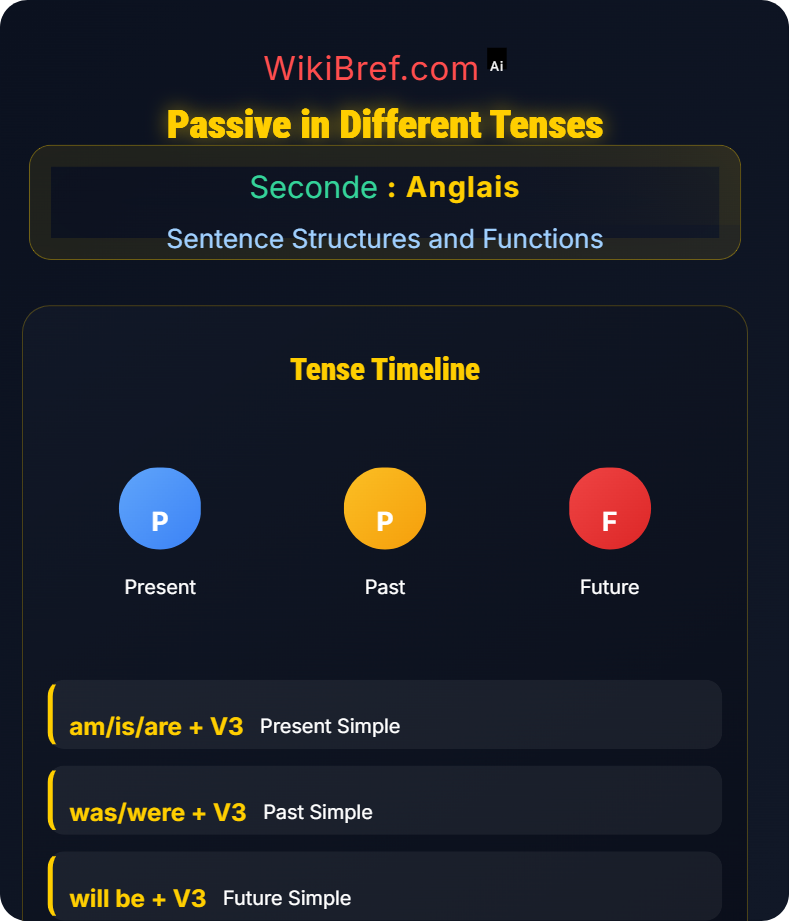
Present: am/is/are + past participle
Present Continuous: am/is/are + being + past participle
Present Continuous: am/is/are + being + past participle
Temps présents en voix passive
Présent simple:
• English is spoken worldwide
• The house is cleaned every day
• Books are read by students
• The house is cleaned every day
• Books are read by students
Présent continu:
• The house is being cleaned now
• The report is being written
• The walls are being painted
• The report is being written
• The walls are being painted
Passé Simple & Composé
was/were + past participle
had been + past participle
have/has been + past participle
was/were + being + past participle
Passé simple:
• The letter was delivered yesterday
• The castle was built in 1800
• The test was corrected by the teacher
• The castle was built in 1800
• The test was corrected by the teacher
Passé composé:
• The project has been completed
• The decision has been made
• The tickets have been sold out
• The decision has been made
• The tickets have been sold out
Futur & Conditionnel
Temps futurs:
• will be + past participle
• going to be + past participle
• to be going to be + past participle
• going to be + past participle
• to be going to be + past participle
Le past participle reste inchangé
Seul le verbe "to be" change de forme
Conservez le même temps que la forme active
Les modalités changent comme "would be"
Pratiquez chaque temps séparément
Conditionnel & Subjonctif
Conditionnel:
• The room would be painted
• The report should be reviewed
• The work might be finished
• The report should be reviewed
• The work might be finished
Futur proche:
• The meeting is going to be held
• The results are going to be announced
• The results are going to be announced
Temps Parfaits
Passé parfait:
• Active: I had finished the work
• Passive: The work had been finished
• Active: She had written the letter
• Passive: The letter had been written
• Passive: The work had been finished
• Active: She had written the letter
• Passive: The letter had been written
Futur parfait:
• Active: They will have completed the task
• Passive: The task will have been completed
• Active: We will have finished the project
• Passive: The project will have been finished
• Passive: The task will have been completed
• Active: We will have finished the project
• Passive: The project will have been finished
Conditionnel parfait:
• Active: They would have finished it
• Passive: It would have been finished
• Active: She could have done it
• Passive: It could have been done
• Passive: It would have been finished
• Active: She could have done it
• Passive: It could have been done
Modalités & Exceptions
can → could → be able to
must → have to → need to
need → need to → have to
ought to → should
used to → would (habitude)
Modalités en voix passive
Modaux principaux:
• can → can be + past participle
• must → must be + past participle
• should → should be + past participle
• must → must be + past participle
• should → should be + past participle
Exemples modaux:
• The door can be opened
• The work must be finished
• The report should be reviewed
• The work must be finished
• The report should be reviewed
Tableau Récapitulatif
am/is/are + past participle
was/were + past participle
will be + past participle
have/has been + past participle
had been + past participle
Erreurs Fréquentes
Erreur 1:
• Confondre "is being done" et "has been done"
• Being = en cours | Been = terminé
• Being = en cours | Been = terminé
Erreur 2:
• Oublier que le past participle ne change pas
• Seul "to be" change selon le temps
• Seul "to be" change selon le temps
Erreur 3:
• Ne pas conserver le même temps que l'actif
• The work is done (présent) ≠ was done (passé)
• The work is done (présent) ≠ was done (passé)