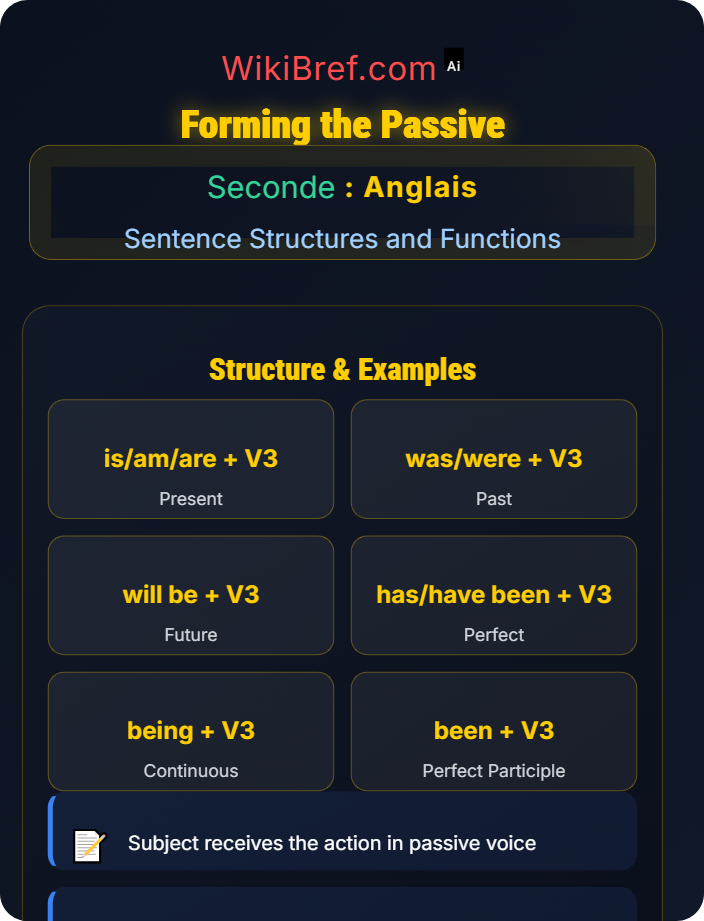
Passive voice : Mettre l'objet "houses" en sujet de la phrase.
- Identifier le sujet ("they"), verbe ("build"), objet ("houses")
- Transformer: objet → sujet, sujet → agent (après "by")
- Appliquer la structure passive: be + past participle
- Conserver le temps: present simple → am/is/are + past participle
"They build houses" → Sujet: "they", Verbe: "build", Objet: "houses"
Objet "houses" devient sujet → "Houses are..."
"Houses" est pluriel → utiliser "are"
"Build" → "built" (verbe irrégulier)
"by them" (correspond à "they" mais au datif)
"Houses are built (by them)"
• Structure passive: S + am/is/are + past participle
• Verbe irrégulier: build → built
• Temps conservé: Present simple → are + past participle
Passive voice : Mettre l'objet "letters" en sujet de la phrase.
"She writes letters" → Sujet: "she", Verbe: "writes", Objet: "letters"
Objet "letters" devient sujet → "Letters are..."
"Letters" est pluriel → utiliser "are"
"Write" → "written" (verbe irrégulier)
"Letters are written (by her)"
"Letters are written (by her)"
• Structure passive: S + am/is/are + past participle
• Verbe irrégulier: write → written
• Temps conservé: Present simple → are + past participle
Passive voice : Mettre l'objet "new employees" en sujet de la phrase.
"The company hired new employees" → Sujet: "the company", Verbe: "hired", Objet: "new employees"
Objet "new employees" devient sujet → "New employees were..."
"New employees" est pluriel → utiliser "were"
"Hire" → "hired" (verbe régulier: hire + -ed)
"New employees were hired (by the company)"
"New employees were hired (by the company)"
• Structure passive: S + was/were + past participle
• Verbe régulier: hire → hired
• Temps conservé: Past simple → were + past participle
Passive voice : Mettre l'objet "the window" en sujet de la phrase.
"Someone broke the window" → Sujet: "someone", Verbe: "broke", Objet: "the window"
Objet "the window" devient sujet → "The window was..."
"The window" est singulier → utiliser "was"
"Break" → "broken" (verbe irrégulier)
"The window was broken (by someone)"
"The window was broken (by someone)"
• Structure passive: S + was/were + past participle
• Verbe irrégulier: break → broken
• Temps conservé: Past simple → was + past participle
Passive voice : Mettre l'objet "a book" en sujet de la phrase.
"We are reading a book" → Sujet: "we", Verbe: "are reading", Objet: "a book"
Objet "a book" devient sujet → "A book is being..."
"A book" est singulier → utiliser "is"
"Is being read" (présent continuous passive)
"Read" → "read" (verbe irrégulier: read-read-read)
"A book is being read (by us)"
• Present continuous passive: is/are + being + past participle
• Verbe irrégulier: read → read (participe passé identique)
• Temps conservé: Present continuous → is being + past participle
Passive voice : Mettre l'objet "the exercises" en sujet de la phrase.
"The teacher corrected the exercises" → Sujet: "the teacher", Verbe: "corrected", Objet: "the exercises"
Objet "the exercises" devient sujet → "The exercises were..."
"The exercises" est pluriel → utiliser "were"
"Correct" → "corrected" (verbe régulier: correct + -ed)
"The exercises were corrected (by the teacher)"
"The exercises were corrected (by the teacher)"
• Structure passive: S + was/were + past participle
• Verbe régulier: correct → corrected
• Temps conservé: Past simple → were + past participle
Passive voice : Mettre l'objet "the project" en sujet de la phrase.
"They will finish the project" → Sujet: "they", Verbe: "will finish", Objet: "the project"
Objet "the project" devient sujet → "The project will be..."
"Will be" pour le futur
"Finish" → "finished" (verbe régulier: finish + -ed)
"The project will be finished (by them)"
"The project will be finished (by them)"
• Future passive: will + be + past participle
• Verbe régulier: finish → finished
• Temps conservé: Future simple → will be + past participle
Passive voice : Mettre l'objet "the suspect" en sujet de la phrase.
"The police arrested the suspect" → Sujet: "the police", Verbe: "arrested", Objet: "the suspect"
Objet "the suspect" devient sujet → "The suspect was..."
"The suspect" est singulier → utiliser "was"
"Arrest" → "arrested" (verbe régulier: arrest + -ed)
"The suspect was arrested (by the police)"
"The suspect was arrested (by the police)"
• Structure passive: S + was/were + past participle
• Verbe régulier: arrest → arrested
• Temps conservé: Past simple → was + past participle
Passive voice : Mettre l'objet "this picture" en sujet de la phrase.
"The artist painted this picture" → Sujet: "the artist", Verbe: "painted", Objet: "this picture"
Objet "this picture" devient sujet → "This picture was..."
"This picture" est singulier → utiliser "was"
"Paint" → "painted" (verbe régulier: paint + -ed)
"This picture was painted (by the artist)"
"This picture was painted (by the artist)"
• Structure passive: S + was/were + past participle
• Verbe régulier: paint → painted
• Temps conservé: Past simple → was + past participle
Passive voice : Mettre l'objet "a new planet" en sujet de la phrase.
"Scientists discovered a new planet" → Sujet: "scientists", Verbe: "discovered", Objet: "a new planet"
Objet "a new planet" devient sujet → "A new planet was..."
"A new planet" est singulier → utiliser "was"
"Discover" → "discovered" (verbe régulier: discover + -ed)
"A new planet was discovered (by scientists)"
"A new planet was discovered (by scientists)"
• Structure passive: S + was/were + past participle
• Verbe régulier: discover → discovered
• Temps conservé: Past simple → was + past participle