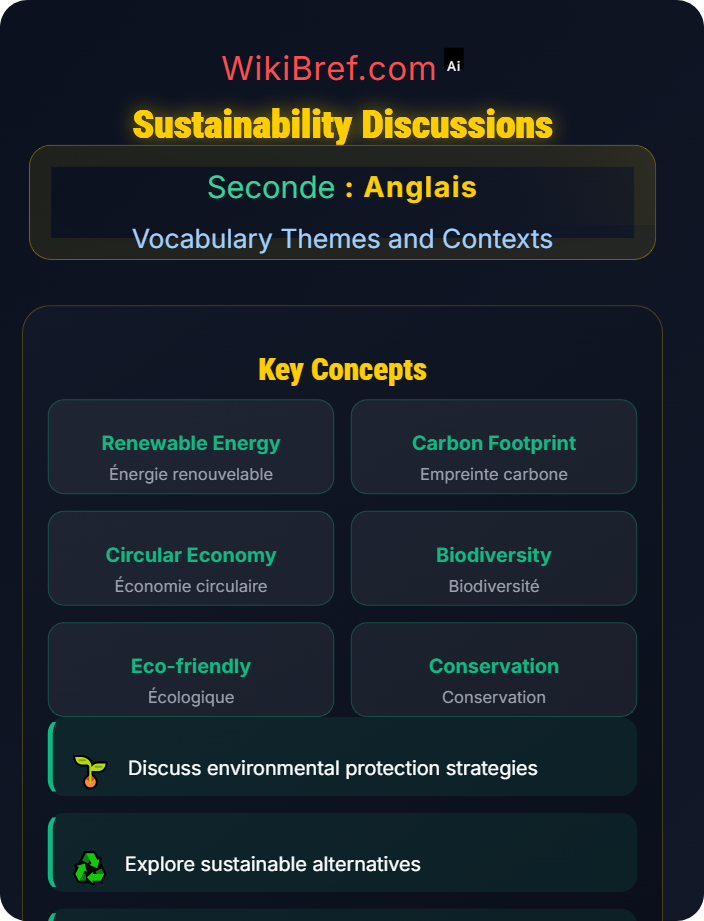
Sustainability discussion : Échange oral structuré sur des pratiques environnementales et sociales responsables.
- Présenter un argument clair
- Donner des preuves ou exemples
- Utiliser des expressions de liaison
- Reconnaître les points de vue opposés
- Proposer des solutions concrètes
"In my opinion, recycling plays a crucial role in environmental sustainability."
"It helps reduce waste in landfills, conserves natural resources, and decreases pollution."
"For example, recycling aluminum cans saves 95% of the energy needed to produce new ones from raw materials."
"We should promote recycling programs in schools and communities to maximize participation."
"In my opinion, recycling plays a crucial role in environmental sustainability. It helps reduce waste in landfills, conserves natural resources, and decreases pollution. For example, recycling aluminum cans saves 95% of the energy needed to produce new ones from raw materials. We should promote recycling programs in schools and communities to maximize participation."
• Structure : Opinion → Avantages → Exemples → Solutions
• Expressivité : Utilisation de "In my opinion", "For example"
• Factuelle : Données chiffrées pour étayer l'argument
Renewable energy : Sources d'énergie naturelles qui se régénèrent plus rapidement qu'elles ne sont consommées.
"Renewable energy sources include solar, wind, hydroelectric, geothermal, and biomass energy."
"They produce little to no greenhouse gas emissions, helping combat climate change and air pollution."
"Although initial investments are high, operational costs are low, and prices continue to decrease."
"Unlike fossil fuels, renewable sources are inexhaustible and available globally."
"Renewable energy sources include solar, wind, hydroelectric, geothermal, and biomass energy. They produce little to no greenhouse gas emissions, helping combat climate change and air pollution. Although initial investments are high, operational costs are low, and prices continue to decrease. Unlike fossil fuels, renewable sources are inexhaustible and available globally."
• Classification : Identifier les différentes sources
• Arguments : Présenter plusieurs types d'avantages
• Contraste : Comparer avec les alternatives
Biodiversity : Variété des formes de vie sur Terre, incluant les espèces animales, végétales et microbiennes.
"Biodiversity refers to the variety of life forms within ecosystems, including species diversity, genetic diversity, and ecosystem diversity."
"It maintains ecosystem stability, provides essential services like pollination and water purification, and supports food webs."
"Biodiversity contributes to pharmaceuticals, agriculture, tourism, and countless industries that depend on natural resources."
"Unfortunately, habitat destruction, climate change, pollution, and overexploitation threaten biodiversity worldwide."
"Biodiversity refers to the variety of life forms within ecosystems, including species diversity, genetic diversity, and ecosystem diversity. It maintains ecosystem stability, provides essential services like pollination and water purification, and supports food webs. Biodiversity contributes to pharmaceuticals, agriculture, tourism, and countless industries that depend on natural resources. Unfortunately, habitat destruction, climate change, pollution, and overexploitation threaten biodiversity worldwide."
• Écologie : Expliquer les fonctions écologiques
• Économie : Montrer les aspects économiques
• Menaces : Identifier les dangers concrets
Sustainable behavior : Actions quotidiennes visant à réduire l'impact environnemental et promouvoir la durabilité.
"Education and awareness campaigns can inform people about the environmental impact of their choices."
"Leading by example demonstrates that sustainable practices are achievable and beneficial."
"Governments and organizations can offer incentives like tax breaks, rebates, or rewards for eco-friendly behaviors."
"Making sustainable options more accessible and affordable encourages widespread adoption."
"Education and awareness campaigns can inform people about the environmental impact of their choices. Leading by example demonstrates that sustainable practices are achievable and beneficial. Governments and organizations can offer incentives like tax breaks, rebates, or rewards for eco-friendly behaviors. Making sustainable options more accessible and affordable encourages widespread adoption."
• Stratégies : Identifier différentes approches
• Pratique : Donner des solutions concrètes
• Accessibilité : Souligner l'importance de la facilité d'accès
Circular economy : Modèle économique qui vise à réduire les déchets en réutilisant, réparant et recyclant les produits.
"The circular economy is an economic model that aims to eliminate waste and continuously use resources by designing products for longevity, repairability, and recyclability."
"This contrasts with the linear model of 'take-make-dispose' that depletes finite resources and creates waste."
"Key principles include designing out waste, keeping products in use, and regenerating natural systems."
"Examples include product-as-a-service models, repair cafes, sharing economies, and cradle-to-cradle manufacturing."
"The circular economy is an economic model that aims to eliminate waste and continuously use resources by designing products for longevity, repairability, and recyclability. This contrasts with the linear model of 'take-make-dispose' that depletes finite resources and creates waste. Key principles include designing out waste, keeping products in use, and regenerating natural systems. Examples include product-as-a-service models, repair cafes, sharing economies, and cradle-to-cradle manufacturing."
• Modèle : Expliquer le concept de base
• Contraste : Comparer avec le modèle traditionnel
• Principe : Identifier les fondements théoriques
Transportation emissions : Gaz à effet de serre et polluants libérés par les véhicules terrestres, maritimes et aériens.
"Transportation accounts for approximately 24% of global CO₂ emissions, making it a major contributor to climate change."
"It produces air pollutants like nitrogen oxides (NOₓ), particulate matter, and volatile organic compounds that harm air quality."
"Transportation also causes noise pollution, habitat fragmentation, and resource consumption for fuel and infrastructure."
"Solutions include electric vehicles, public transportation, cycling infrastructure, and remote work to reduce commuting."
"Transportation accounts for approximately 24% of global CO₂ emissions, making it a major contributor to climate change. It produces air pollutants like nitrogen oxides (NOₓ), particulate matter, and volatile organic compounds that harm air quality. Transportation also causes noise pollution, habitat fragmentation, and resource consumption for fuel and infrastructure. Solutions include electric vehicles, public transportation, cycling infrastructure, and remote work to reduce commuting."
• Quantitatif : Donner des statistiques précises
• Complet : Aborder plusieurs types d'impacts
• Solutions : Proposer des alternatives concrètes
Sustainable food : Aliments produits de manière à minimiser l'impact environnemental et favoriser le bien-être social.
"Sustainable food production considers environmental health, economic profitability, and social equity throughout the supply chain."
"It reduces greenhouse gas emissions, preserves biodiversity, protects water resources, and maintains soil health."
"Examples include organic farming, local sourcing, seasonal eating, reduced meat consumption, and minimal packaging."
"Challenges include higher costs, limited availability, and consumer preferences for convenience over sustainability."
"Sustainable food production considers environmental health, economic profitability, and social equity throughout the supply chain. It reduces greenhouse gas emissions, preserves biodiversity, protects water resources, and maintains soil health. Examples include organic farming, local sourcing, seasonal eating, reduced meat consumption, and minimal packaging. Challenges include higher costs, limited availability, and consumer preferences for convenience over sustainability."
• Triple bottom line : Équilibre environnemental, économique et social
• Pratique : Donner des exemples concrets
• Réaliste : Reconnaître les obstacles
Green building : Construction conçue pour minimiser l'impact environnemental tout en maximisant l'efficacité énergétique.
"Sustainable buildings incorporate energy-efficient design, renewable energy systems, water conservation, and sustainable materials."
"Techniques include passive solar design, high-performance insulation, efficient lighting, smart HVAC systems, and rainwater harvesting."
"Certification programs like LEED, BREEAM, and ENERGY STAR verify sustainable building performance and practices."
"Benefits include reduced operating costs, improved indoor air quality, lower environmental impact, and increased property value."
"Sustainable buildings incorporate energy-efficient design, renewable energy systems, water conservation, and sustainable materials. Techniques include passive solar design, high-performance insulation, efficient lighting, smart HVAC systems, and rainwater harvesting. Certification programs like LEED, BREEAM, and ENERGY STAR verify sustainable building performance and practices. Benefits include reduced operating costs, improved indoor air quality, lower environmental impact, and increased property value."
• Technique : Expliquer les méthodes de construction
• Normatif : Mentionner les certifications reconnues
• Avantages : Montrer les bénéfices multiples
Corporate sustainability : Engagement des entreprises à intégrer des pratiques responsables dans leurs opérations.
"Companies have significant environmental and social impact due to their scale of operations and resource consumption."
"Initiatives include carbon neutrality goals, sustainable supply chains, circular economy adoption, and stakeholder engagement."
"Sustainable practices can reduce costs, attract conscious consumers, improve employee satisfaction, and mitigate regulatory risks."
"Challenges include balancing profit margins with sustainability goals, measuring impact, and ensuring supplier compliance."
"Companies have significant environmental and social impact due to their scale of operations and resource consumption. Initiatives include carbon neutrality goals, sustainable supply chains, circular economy adoption, and stakeholder engagement. Sustainable practices can reduce costs, attract conscious consumers, improve employee satisfaction, and mitigate regulatory risks. Challenges include balancing profit margins with sustainability goals, measuring impact, and ensuring supplier compliance."
• Échelle : Souligner l'impact des grandes organisations
• Équilibre : Reconnaître les tensions entre profit et durabilité
• Stratégique : Expliquer les avantages concurrentiels
Individual sustainability : Actions personnelles visant à réduire l'empreinte environnementale et promouvoir des pratiques responsables.
"Individuals can contribute through transportation choices, consumption habits, energy use, and waste management."
"Specific actions include using public transport, reducing meat consumption, choosing renewable energy, buying less and better, and recycling properly."
"While individual actions seem small, collective behavior change can create significant environmental impact."
"Individuals can also raise awareness, vote for environmentally conscious leaders, and support sustainable businesses."
"Individuals can contribute through transportation choices, consumption habits, energy use, and waste management. Specific actions include using public transport, reducing meat consumption, choosing renewable energy, buying less and better, and recycling properly. While individual actions seem small, collective behavior change can create significant environmental impact. Individuals can also raise awareness, vote for environmentally conscious leaders, and support sustainable businesses."
• Pratique : Donner des conseils applicables
• Collectif : Souligner l'effet d'entraînement
• Citoyenneté : Inclure l'engagement politique