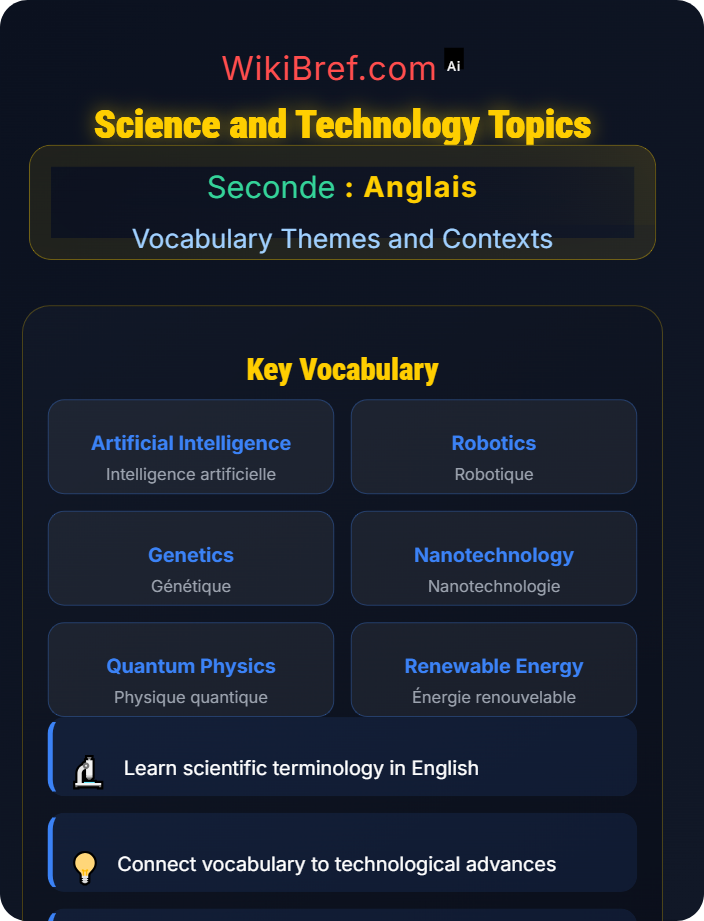
Artificial intelligence (AI) : Simulation de l'intelligence humaine par des machines programmées pour imiter des fonctions cognitives.
- Définir le terme de manière claire
- Expliquer le fonctionnement de base
- Donner des exemples d'applications
- Indiquer les types d'IA
- Discuter des implications
"Artificial intelligence (AI) refers to computer systems designed to perform tasks that typically require human intelligence."
"AI systems learn from data, recognize patterns, make decisions, and solve problems using algorithms and machine learning models."
"Applications include virtual assistants (Siri, Alexa), recommendation systems (Netflix, Amazon), autonomous vehicles, medical diagnosis, and fraud detection."
"Types include narrow AI (focused on specific tasks), general AI (human-level intelligence), and superintelligent AI (surpassing human capabilities)."
"AI raises ethical questions about privacy, job displacement, bias, and the need for responsible development and regulation."
"Artificial intelligence (AI) refers to computer systems designed to perform tasks that typically require human intelligence. AI systems learn from data, recognize patterns, make decisions, and solve problems using algorithms and machine learning models. Applications include virtual assistants (Siri, Alexa), recommendation systems (Netflix, Amazon), autonomous vehicles, medical diagnosis, and fraud detection. Types include narrow AI (focused on specific tasks), general AI (human-level intelligence), and superintelligent AI (surpassing human capabilities). AI raises ethical questions about privacy, job displacement, bias, and the need for responsible development and regulation."
• Structure : Définition → Mécanisme → Applications → Types → Implications
• Technique : Utilisation de termes précis et techniques
• Contemporain : Inclusion des enjeux éthiques et sociétaux
Biotechnology : Application de la science et de la technologie aux organismes vivants pour produire des biens et services.
"Biotechnology involves using living organisms, cells, or biological processes to develop products and technologies that improve human lives and the planet."
"Major areas include medicine (vaccines, gene therapy), agriculture (GM crops, pest resistance), industry (biofuels, enzymes), and environmental science (waste treatment)."
"Key techniques include genetic engineering, cell culture, fermentation, PCR (Polymerase Chain Reaction), and CRISPR gene editing."
"Benefits include improved crop yields, new medical treatments, cleaner industrial processes, and solutions to environmental challenges."
"Biotechnology involves using living organisms, cells, or biological processes to develop products and technologies that improve human lives and the planet. Major areas include medicine (vaccines, gene therapy), agriculture (GM crops, pest resistance), industry (biofuels, enzymes), and environmental science (waste treatment). Key techniques include genetic engineering, cell culture, fermentation, PCR (Polymerase Chain Reaction), and CRISPR gene editing. Benefits include improved crop yields, new medical treatments, cleaner industrial processes, and solutions to environmental challenges."
• Domaines : Classification des applications par secteur
• Techniques : Identification des méthodes principales
• Avantages : Présentation des bénéfices potentiels
Nanotechnology : Manipulation de la matière à l'échelle atomique et moléculaire (1-100 nanomètres).
"Nanotechnology involves manipulating matter at the atomic and molecular scale, typically between 1 and 100 nanometers, where unique properties emerge."
"One nanometer equals one billionth of a meter (10⁻⁹ m), roughly 1/80,000 the width of a human hair."
"Medical applications include targeted drug delivery systems, cancer treatment, diagnostic tools, and tissue engineering for regenerative medicine."
"Examples: stain-resistant fabrics, scratch-resistant coatings, improved batteries, water purification systems, and quantum dots for imaging."
"Nanotechnology involves manipulating matter at the atomic and molecular scale, typically between 1 and 100 nanometers, where unique properties emerge. One nanometer equals one billionth of a meter (10⁻⁹ m), roughly 1/80,000 the width of a human hair. Medical applications include targeted drug delivery systems, cancer treatment, diagnostic tools, and tissue engineering for regenerative medicine. Examples: stain-resistant fabrics, scratch-resistant coatings, improved batteries, water purification systems, and quantum dots for imaging."
• Échelle : Préciser les dimensions spécifiques
• Quantification : Donner des mesures comparatives
• Applications : Fournir des exemples variés et concrets
Renewable energy : Énergie provenant de sources naturelles qui se régénèrent plus rapidement qu'elles ne sont consommées.
"Clean energy, green energy, sustainable energy, alternative energy, and eco-friendly energy are synonyms for renewable energy."
"Clean energy emphasizes low environmental impact, green energy highlights environmental benefits, and sustainable energy focuses on long-term availability."
"Sources include solar power, wind power, hydroelectricity, geothermal energy, biomass, and tidal energy."
"Unlike fossil fuels, renewable energy sources do not deplete and produce significantly fewer emissions."
"Synonyms for renewable energy include: Clean energy, green energy, sustainable energy, alternative energy, and eco-friendly energy. Clean energy emphasizes low environmental impact, green energy highlights environmental benefits, and sustainable energy focuses on long-term availability. Sources include solar power, wind power, hydroelectricity, geothermal energy, biomass, and tidal energy. Unlike fossil fuels, renewable energy sources do not deplete and produce significantly fewer emissions."
• Synonymie : Fournir des alternatives linguistiques
• Nuances : Expliquer les différences subtiles entre termes
• Contraste : Comparer avec les concepts opposés
Scientific method : Processus systématique d'investigation basé sur l'observation, l'expérimentation et l'analyse.
"The scientific method is a systematic approach to investigating phenomena, acquiring new knowledge, or correcting and integrating previous knowledge."
"Steps include: observation, question formulation, hypothesis development, experimentation, data collection, analysis, and conclusion drawing."
"Scientists observe natural phenomena and identify patterns or problems that need explanation."
"A hypothesis is a testable prediction that explains the observed phenomenon based on prior knowledge and logical reasoning."
"Experiments are designed to test hypotheses under controlled conditions to establish cause-and-effect relationships."
"The scientific method is a systematic approach to investigating phenomena, acquiring new knowledge, or correcting and integrating previous knowledge. Steps include: observation, question formulation, hypothesis development, experimentation, data collection, analysis, and conclusion drawing. Scientists observe natural phenomena and identify patterns or problems that need explanation. A hypothesis is a testable prediction that explains the observed phenomenon based on prior knowledge and logical reasoning. Experiments are designed to test hypotheses under controlled conditions to establish cause-and-effect relationships."
• Systématique : Présenter les étapes dans l'ordre logique
• Méthodologie : Expliquer chaque étape avec précision
• Processus : Montrer la nature itérative de la méthode
Space exploration : Investigation des objets célestes et du cosmos par l'envoi de vaisseaux spatiaux et d'astronautes.
"Space exploration involves the investigation of celestial bodies and outer space using spacecraft, satellites, and human missions to expand our understanding of the universe."
"Key milestones include the launch of Sputnik 1 (1957), the first human in space (Yuri Gagarin, 1961), and the Moon landing (Apollo 11, 1969)."
"Technologies include rockets, satellites, space stations, rovers, telescopes, and life support systems for astronauts."
"Benefits include scientific discoveries, technological innovations, Earth monitoring, satellite communications, and potential solutions to resource limitations."
"Space exploration involves the investigation of celestial bodies and outer space using spacecraft, satellites, and human missions to expand our understanding of the universe. Key milestones include the launch of Sputnik 1 (1957), the first human in space (Yuri Gagarin, 1961), and the Moon landing (Apollo 11, 1969). Technologies include rockets, satellites, space stations, rovers, telescopes, and life support systems for astronauts. Benefits include scientific discoveries, technological innovations, Earth monitoring, satellite communications, and potential solutions to resource limitations."
• Histoire : Inclure les jalons historiques importants
• Technologie : Lier aux innovations techniques
• Avantages : Souligner les bénéfices concrets
Genetic engineering : Modification directe des gènes d'un organisme pour produire des caractères désirés.
"Genetic engineering involves directly manipulating an organism's DNA using biotechnology to alter its characteristics or produce desired traits."
"Methods include gene splicing, recombinant DNA technology, CRISPR-Cas9 gene editing, and transgenic organism creation."
"Medical applications include gene therapy for genetic disorders, insulin production, vaccine development, and personalized medicine."
"Agricultural uses include pest-resistant crops, herbicide tolerance, enhanced nutritional content, and climate adaptation."
"Ethical considerations involve safety concerns, environmental impact, genetic modification of humans, and equitable access to treatments."
"Genetic engineering involves directly manipulating an organism's DNA using biotechnology to alter its characteristics or produce desired traits. Methods include gene splicing, recombinant DNA technology, CRISPR-Cas9 gene editing, and transgenic organism creation. Medical applications include gene therapy for genetic disorders, insulin production, vaccine development, and personalized medicine. Agricultural uses include pest-resistant crops, herbicide tolerance, enhanced nutritional content, and climate adaptation. Ethical considerations involve safety concerns, environmental impact, genetic modification of humans, and equitable access to treatments."
• Technique : Expliquer les méthodes précises
• Applications : Montrer les domaines d'utilisation
• Éthique : Aborder les questions morales importantes
Cybersecurity : Protection des systèmes informatiques, réseaux et données contre les cyberattaques.
"Cybersecurity encompasses practices, technologies, and processes designed to protect networks, devices, programs, and data from attack, damage, or unauthorized access."
"Major threats include malware, phishing, ransomware, identity theft, data breaches, and denial-of-service attacks."
"Protection methods include firewalls, antivirus software, encryption, multi-factor authentication, regular updates, and security awareness training."
"With increasing digitalization, cybersecurity has become critical for individuals, businesses, and governments to prevent financial loss and protect privacy."
"Cybersecurity encompasses practices, technologies, and processes designed to protect networks, devices, programs, and data from attack, damage, or unauthorized access. Major threats include malware, phishing, ransomware, identity theft, data breaches, and denial-of-service attacks. Protection methods include firewalls, antivirus software, encryption, multi-factor authentication, regular updates, and security awareness training. With increasing digitalization, cybersecurity has become critical for individuals, businesses, and governments to prevent financial loss and protect privacy."
• Sécurité : Expliquer les menaces et protections
• Actualité : Souligner l'importance contemporaine
• Pratique : Donner des solutions concrètes
Clinical trials : Recherches scientifiques qui testent l'efficacité et la sécurité de nouveaux traitements médicaux.
"Clinical trials are research studies that evaluate the effectiveness and safety of new medications, treatments, or medical procedures in human participants."
"Clinical trials proceed through four phases: Phase I (safety, small groups), Phase II (efficacy, larger groups), Phase III (comparison with standard treatment), and Phase IV (post-market surveillance)."
"Participants must provide informed consent after being fully informed about the study's purpose, procedures, risks, and benefits."
"Examples include testing new cancer drugs, evaluating vaccine effectiveness, comparing surgical techniques, and assessing medical device safety."
"Clinical trials are research studies that evaluate the effectiveness and safety of new medications, treatments, or medical procedures in human participants. Clinical trials proceed through four phases: Phase I (safety, small groups), Phase II (efficacy, larger groups), Phase III (comparison with standard treatment), and Phase IV (post-market surveillance). Participants must provide informed consent after being fully informed about the study's purpose, procedures, risks, and benefits. Examples include testing new cancer drugs, evaluating vaccine effectiveness, comparing surgical techniques, and assessing medical device safety."
• Scientifique : Expliquer la méthodologie rigoureuse
• Éthique : Souligner l'importance du consentement
• Phases : Présenter l'approche progressive
Automation : Utilisation de technologies pour effectuer des tâches avec peu ou pas d'intervention humaine.
"Automation refers to the use of control systems and technology to operate equipment and processes with minimal human intervention."
"Types include industrial automation (manufacturing robots), home automation (smart thermostats), automotive automation (self-driving cars), and office automation (workflow software)."
"Benefits include increased efficiency, reduced costs, improved quality and precision, enhanced safety, and 24/7 operation capability."
"Challenges include job displacement, high initial investment, technical complexity, and potential security vulnerabilities in automated systems."
"Automation refers to the use of control systems and technology to operate equipment and processes with minimal human intervention. Types include industrial automation (manufacturing robots), home automation (smart thermostats), automotive automation (self-driving cars), and office automation (workflow software). Benefits include increased efficiency, reduced costs, improved quality and precision, enhanced safety, and 24/7 operation capability. Challenges include job displacement, high initial investment, technical complexity, and potential security vulnerabilities in automated systems."
• Classification : Expliquer les différents types
• Équilibre : Présenter avantages et inconvénients
• Sociétal : Aborder les impacts sur le travail