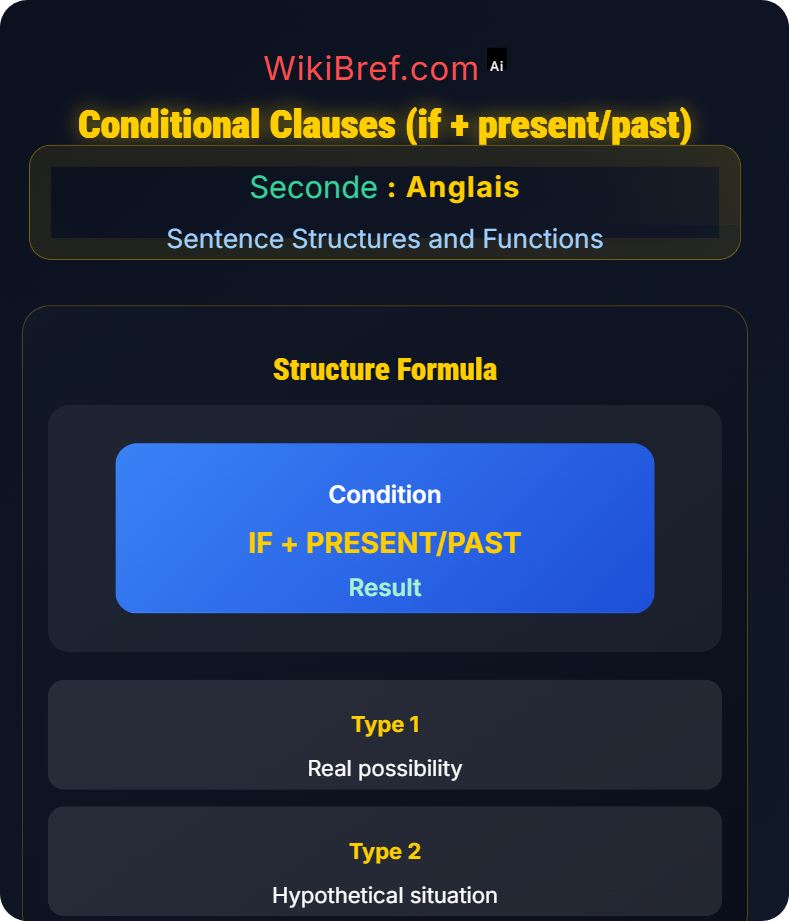
Définition & Structure
Conditional Clause: If + Condition + Result
(Real conditions in present or past)
(Real conditions in present or past)
Type 1 (présent):
If it rains, I stay inside
If you study hard, you pass the exam
If she comes, we'll be happy
If you study hard, you pass the exam
If she comes, we'll be happy
Type 2 (passé):
If I had money, I would travel
If she studied, she would pass
If it were sunny, we'd go out
If she studied, she would pass
If it were sunny, we'd go out
Règles fondamentales
Type 1: possible dans le présent
If clause = condition
Main clause = résultat
Type 2: hypothétique
Types de conditionnels
Type 1: If + present, will + verb
Type 2: If + past, would + verb
Type 1: probabilité réelle
Type 2: situation irréelle
Structures détaillées
Type 1 (présent):
If + present simple → will + base verb
If you study → you will pass
If it snows → schools close
If you study → you will pass
If it snows → schools close
Type 2 (passé):
If + past simple → would + base verb
If I had time → I would help
If she were here → she would agree
If I had time → I would help
If she were here → she would agree
Conseils & Astuces
Type 1: situations réalistes
Type 2: situations hypothétiques
If peut être au début ou à la fin
Pratiquez les deux ordres possibles
Type 2: souvent avec "would like to"
Exemples de pratique
Exercice 1:
Complétez: "If it rains, _____" → "we'll stay home"
Exercice 2:
Transformez: "Study hard" → "If you study hard, you will succeed"
Exercice 3:
Identifiez: "If I had more time, I would travel" → Type 2