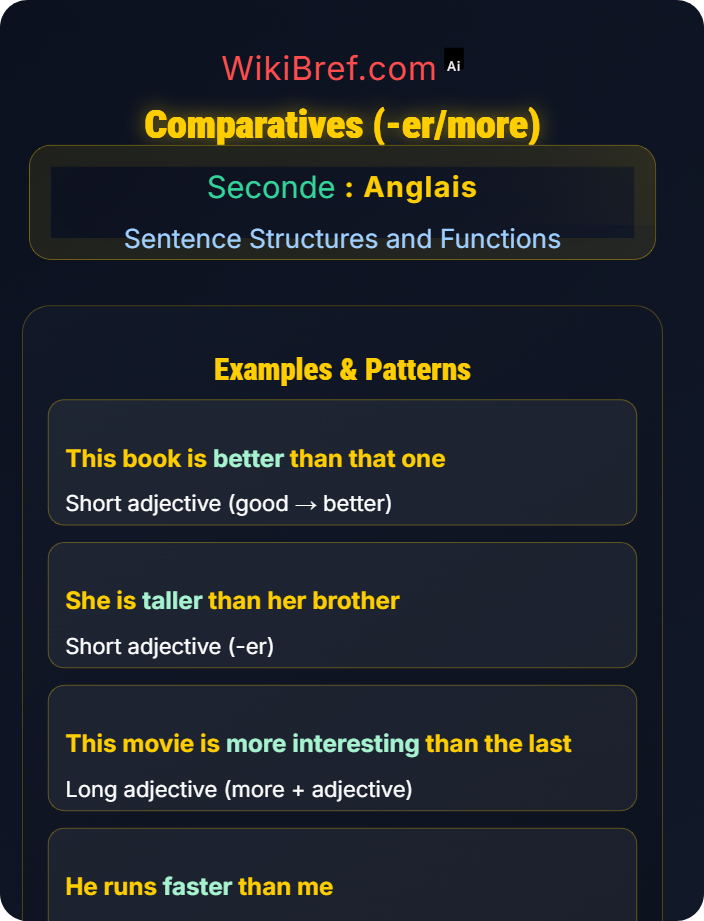
| Type | Forme | Exemple | Exemple comparatif |
|---|---|---|---|
| Short adjective | + -er | fast | faster than |
| Short adjective | + -er (consonant) | big | bigger than |
| Short adjective | + -ier (y) | happy | happier than |
| Long adjective | more + adjective | beautiful | more beautiful than |
| Irregular | formes spéciales | good | better than |
| Irregular | formes spéciales | bad | worse than |
Comparative -er : Pour les adjectifs courts (1-2 syllabes).
"Tall" → 1 syllabe → Forme courte
Adjectif court → Ajouter -er
"tall" → "taller"
"John is taller than Peter"
Sujet + verbe + adjectif + -er + than + complément
John is taller than Peter
• Adjectifs courts : 1 syllabe → -er
• Structure : Sujet + verbe + adjectif + -er + than
• Comparaison : Entre deux éléments
Comparative more : Pour les adjectifs longs (2+ syllabes).
"Expensive" → 3 syllabes (ex-pen-sive) → Forme longue
Adjectif long → Utiliser "more"
"expensive" → "more expensive"
"This car is more expensive than that one"
Sujet + verbe + more + adjectif + than
This car is more expensive than that one
• Adjectifs longs : 2+ syllabes → more + adjectif
• Structure : Sujet + verbe + more + adjectif + than
• Comparaison : Entre deux éléments
Comparative -er : Pour les adjectifs courts se terminant en consonne.
"Fast" → 1 syllabe, se termine en consonne → Double la consonne
Consonne finale → Doubler la consonne avant -er
"fast" → "faster" (pas de doublement nécessaire)
"She runs faster than her sister"
Sujet + verbe + adjectif + -er + than
She runs faster than her sister
• Consonne finale : Parfois double la consonne (mais "fast" est exception)
• Structure : Sujet + verbe + adjectif + -er + than
• Adverbe : "Runs" → Utilisation comme adverbe
Comparative more : Pour les adjectifs longs.
"Interesting" → 3 syllabes (in-ter-es-ting) → Forme longue
Adjectif long → Utiliser "more"
"interesting" → "more interesting"
"This movie is more interesting than the previous one"
Sujet + verbe + more + adjectif + than
This movie is more interesting than the previous one
• Adjectifs longs : 2+ syllabes → more + adjectif
• Structure : Sujet + verbe + more + adjectif + than
• Comparaison : Entre deux éléments
Comparative -ier : Pour les adjectifs courts se terminant en -y.
"Happy" → 2 syllabes, se termine en -y → Change y en i
-y final → Change en -i avant -er
"happy" → "happier" (y → i + er)
"Today is happier than yesterday"
Sujet + verbe + adjectif + -ier + than
Today is happier than yesterday
• -y final : Change en -i avant -er → -ier
• Structure : Sujet + verbe + adjectif + -ier + than
• Transformation : y → i + er
Transformation : Convertir deux phrases simples en une comparaison.
"Mary is intelligent" et "Tom is more intelligent" → Comparaison implicite
Mary vs Tom → Intelligence
Tom est plus intelligent que Mary
"Tom is more intelligent than Mary"
"Mary is less intelligent than Tom"
Tom is more intelligent than Mary
• Transformation : Élimine la répétition
• Comparaison : Entre deux éléments
• Structure : Sujet + verbe + more + adjectif + than + complément
Comparatives irrégulières : Formes spéciales pour certains adjectifs.
"Good" → Adjectif irrégulier
"Good" → "Better" (non "more good")
"good" → "better"
"He is better than last year"
Sujet + verbe + comparative irrégulière + than + complément
He is better than last year
• Irregular forms : Good → Better, Bad → Worse
• Exception : Ne suit pas les règles générales
• Mémorisation : Nécessite apprentissage
Erreurs fréquentes : Doubler les indicateurs de comparaison.
"This book is more better than that one" → "more" + "better"
"More" est utilisé avec des adjectifs réguliers, "better" est irrégulier
"Better" seul ou "more interesting"
"This book is better than that one"
"This book is more interesting than that one"
This book is better than that one
• One indicator : Soit "more", soit forme irrégulière
• Never both : Jamais "more" + forme irrégulière
• Error pattern : Traduction directe de "plus bon"
Comparative double : Structure "the more... the more..." pour relations proportionnelles.
"The more you practice, ___ you become" → Comparative double
Plus de pratique → Plus de compétence → Relation proportionnelle
"The more skilled" ou "the better"
"The more you practice, the better you become"
The + comparative ..., the + comparative ...
The more you practice, the better you become
• Double comparative : The + comparative, the + comparative
• Proportionality : Indique une relation directe
• Structure : Les deux parties sont comparatives
Comparative avec substantif : Comparer des quantités.
"She has ___ money than he does" → Comparer des quantités
Quantité de money → "More" pour la comparaison
"More money" → Quantité
"She has more money than he does"
Sujet + verbe + more + substantif + than + complément
She has more money than he does
• Quantities : More/Less + substantif
• Structure : Sujet + verbe + more + substantif + than
• Countable/Uncountable : Both use more/less