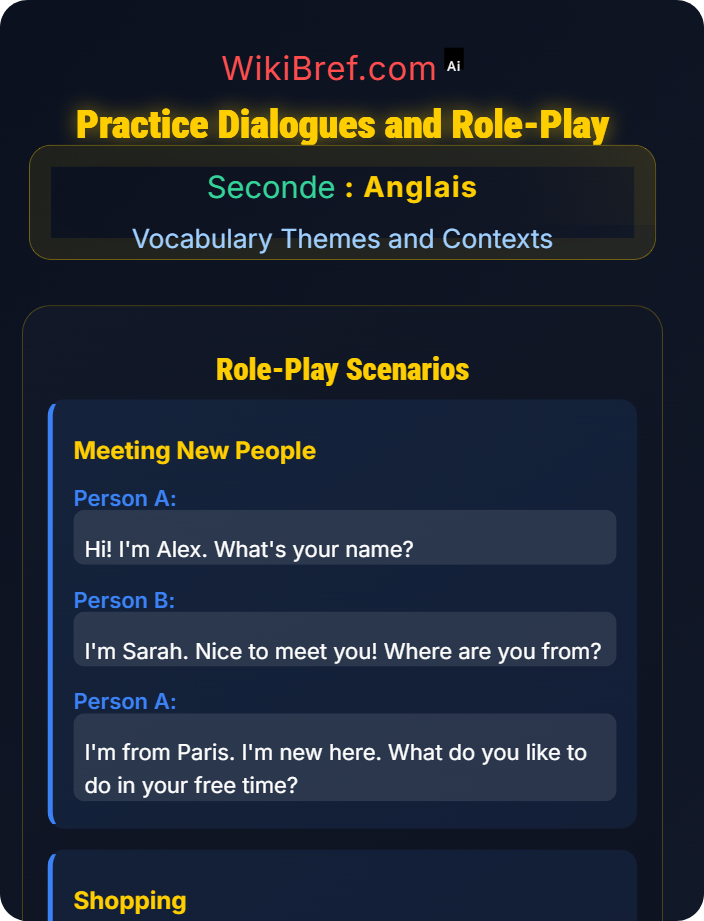
Self-introduction: Presenting oneself and getting to know others.
- Greeting and name introduction
- Asking about interests/hobbies
- Sharing common interests
- Closing with future plans
Start with a friendly greeting and introduce your name
Use questions like "What do you like doing?" or "What are your hobbies?"
Share your own interests and find common ground
End with a friendly suggestion for future interaction
An effective introduction dialogue includes greeting, self-introduction, interest exchange, and a friendly closing suggestion.
• Politeness: Use "Nice to meet you" and "Thank you"
• Questions: Ask open-ended questions to encourage conversation
• Active listening: Show interest in the other person's responses
Shop dialogue: Customer-service interactions with specific vocabulary.
Start with a polite greeting and make your request
Accept offers of assistance and ask specific questions
Ask about prices using "How much does... cost?"
Ask for additional items or information
Effective shop dialogue uses polite requests, specific questions, and shows appreciation for help.
• Politeness: Use "Could you", "Please", "Thank you"
• Specificity: Be clear about what you're looking for
• Gratitude: Acknowledge helpful service
Planning dialogue: Using modal verbs to suggest and negotiate activities.
Make the initial suggestion to spend time together
Propose a specific activity using "Should we..."
Suggest additional activities or details
Decide timing and location for the activity
Weekend planning dialogue effectively uses modal verbs like "should", "could", and "would" to suggest and agree on activities.
• Modal verbs: Use "should", "could", "would" for suggestions
• Agreement: Show willingness with "I'd love to" or "That sounds great"
• Logistics: Discuss timing and location details
Social introduction: Meeting new people in informal settings.
Introduce yourself in a friendly, non-threatening way
Ask about their connection to the event and other details
Discover shared interests or connections
Move to academic or personal interests to build rapport
First meeting conversations start with introductions and gradually move to shared interests and deeper topics.
• Approachability: Start with friendly, open body language
• Gradual disclosure: Move from general to specific topics
• Active engagement: Show genuine interest in the other person
Negotiation dialogue: Discussing responsibilities and timelines.
List all the components that need to be completed
Distribute tasks based on strengths and preferences
Establish realistic timelines for completion
Decide how to stay in touch during the project
Group project negotiation involves task distribution, timeline setting, and communication planning.
• Collaboration: Encourage input from all team members
• Realistic planning: Set achievable deadlines
• Flexibility: Allow for adjustments if needed
Phone etiquette: Professional telephone communication with proper structure.
Identify yourself and state your purpose clearly
Ask about availability while being specific about needs
Evaluate the options provided and choose the best one
Verify all appointment details including time and purpose
Professional phone scheduling follows a structured approach with clear communication of needs and confirmation of details.
• Clarity: State your purpose immediately after greeting
• Flexibility: Consider multiple options when offered
• Confirmation: Repeat important details to avoid mistakes
Advice-giving dialogue: Supporting friends through difficult times.
Show empathy and acknowledge the friend's feelings
Encourage the friend to share more details
Confirm that their emotions are understandable
Provide helpful ideas without being prescriptive
Relationship advice dialogue focuses on empathy, validation, and offering constructive support.
• Empathy: Acknowledge the friend's emotions first
• Non-judgment: Avoid criticizing their partner directly
• Support: Offer encouragement and practical suggestions
Academic assistance: Seeking help from teachers with respect and preparation.
Ask permission to speak and be specific about the problem
Describe exactly what challenges you're facing
Show willingness to implement the teacher's advice
Request additional support when needed
Effective teacher consultation involves respectful approach, specific problem identification, and proactive follow-up.
• Respect: Use formal address and ask permission
• Specificity: Clearly identify the exact problem
• Initiative: Show you're willing to work on solutions
Service interaction: Professional customer service with multiple requests.
State your reservation clearly and provide identification if needed
Get room details and check-in information
Ask for food and restaurant suggestions
Inquire about sightseeing and entertainment options
Hotel check-in dialogue efficiently handles registration followed by information requests about local amenities.
• Efficiency: Handle basic check-in quickly before requesting extras
• Specificity: Ask targeted questions about local services
• Appreciation: Thank staff for their assistance
Customer service: Addressing product issues professionally and constructively.
Describe the issue clearly and mention purchase details
Give detailed information about when and how the problem occurs
Confirm you have proof of purchase and original packaging
Work with service representative to find the best solution
Product complaint dialogue involves clear problem description, documentation provision, and collaborative solution-seeking.
• Clarity: Describe the problem in detail without emotion
• Documentation: Keep receipts and original packaging
• Collaboration: Work with service staff to find solutions